Reviewing process

Initial Editorial Assessment

The peer-review process is conducted in accordance with the COPE Ethical Guidelines for Peer Reviewers . Additional guidance is available in the COPE Ethical Guidelines for Peer Reviewers .

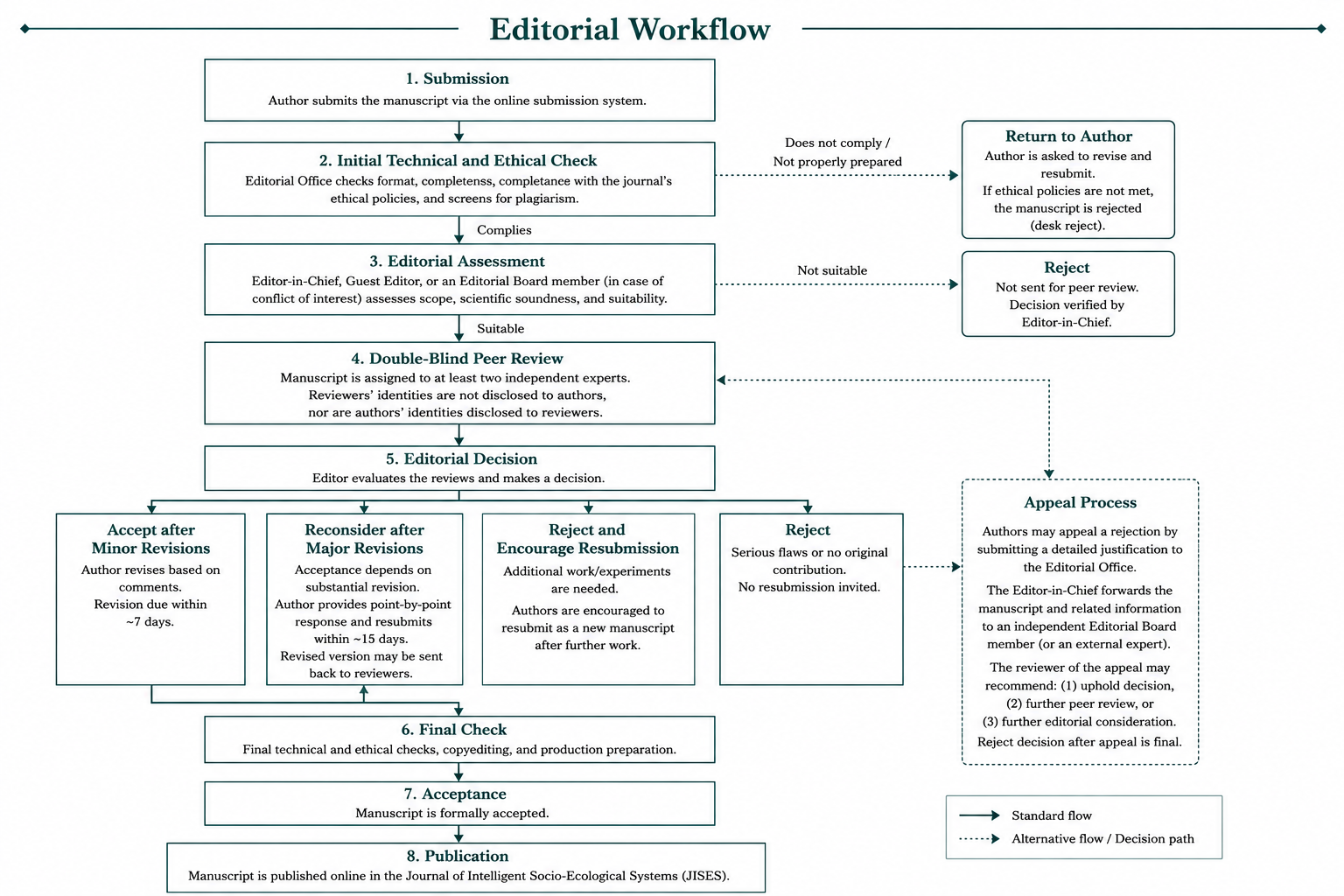
All manuscripts received by the Editorial Office are initially checked to determine whether they have been properly prepared and whether they comply with the journal’s editorial and ethical policies. Manuscripts that do not comply with the journal’s ethical policies may be rejected before peer review. Manuscripts that are not properly prepared may be returned to the authors for revision and resubmission.

Following these initial checks, the Editor-in-Chief, Guest Editor, or an Editorial Board member in cases involving a conflict of interest will determine whether the manuscript falls within the scope of the journal and meets the minimum scientific and methodological standards required for external peer review. No judgment regarding the potential citation impact of the work will be made at this stage. Editorial rejection decisions made at this stage will be subject to oversight by the Editor-in-Chief.

Submissions by Editorial Board Members

Editorial Board members may submit scientific articles to the journal. Such submissions will be handled in a manner that ensures the independence, transparency, rigor, and impartiality of the peer-review process. The submitting Editorial Board member will have no involvement in the editorial assessment, selection of reviewers, peer-review process, or final decision concerning the manuscript.

Particular care will be taken in selecting an independent handling editor and reviewers and in preserving the integrity of the double-blind peer-review process. If the manuscript is accepted for publication, the journal may include an editorial statement describing the measures taken to ensure the independence and transparency of the review process.

Plagiarism Screening

The journal uses appropriate plagiarism-detection software to screen submitted manuscripts for potential plagiarism and inappropriate textual overlap.

Editorial Workflow
Peer Review

Once a manuscript passes the initial editorial checks, it will normally be assigned to at least two independent experts for peer review. The Journal of Intelligent Socio-Ecological Systems (JISES) operates a double-blind peer-review process: the identities of the reviewers are not disclosed to the authors, and the identities of the authors are not disclosed to the reviewers. Peer-review reports and related correspondence are treated as confidential. The Editor is responsible for the final decision regarding the acceptance or rejection of a manuscript.

For regular submissions, the editorial team will invite suitably qualified experts to review the manuscript. Reviewers may include members of the Editorial Board, provided that no conflict of interest exists. For manuscripts submitted to a special issue, the Guest Editor may advise on the selection of reviewers, subject to the journal’s editorial and conflict-of-interest policies.

Potential reviewers suggested by the authors may be considered; however, the journal is under no obligation to invite suggested reviewers. Reviewers must be independent of the authors and should not have relationships or recent research collaborations that could reasonably be perceived as affecting the impartiality of the review. In particular, reviewers should not normally have published with any of the manuscript’s co-authors during the preceding five years and should not currently be affiliated with the same institution as any of the authors.

Reviewers must not request citations to their own work, the work of close colleagues, other authors, or articles from a particular journal unless those citations are genuinely relevant and necessary to improve the scholarly quality of the manuscript. Further information is available in the relevant COPE guidance on citation requests by reviewers .

Reviewers must not upload submitted manuscripts, manuscript content, or other confidential peer-review materials to publicly available generative AI or AI-assisted tools, nor may such tools be used to generate peer-review reports where doing so would compromise the confidentiality of the review process. Reviewers remain fully responsible for the content, accuracy, integrity, and confidentiality of their review reports.

Reviewers should maintain a professional and impartial tone and provide constructive criticism intended to help authors improve their work. Derogatory, hostile, or inappropriate comments will not be tolerated. Reviewers must keep the manuscript and its contents confidential. If a review report does not meet the journal’s quality or ethical standards, the reviewer may be asked to revise the report, or the report may be disregarded by the Editor.

Editorial Decision and Revision

All research articles, reviews, and communications published in the Journal of Intelligent Socio-Ecological Systems (JISES) undergo peer review and normally receive reports from at least two independent reviewers. Following evaluation of the manuscript and the reviewers’ reports, the Editor will communicate one of the following decisions:

Accept after Minor Revisions: The manuscript is considered suitable for publication in principle, subject to satisfactory revision in response to the reviewers’ and Editor’s comments. Authors are normally given seven days to submit minor revisions.
Reconsider after Major Revisions: The manuscript requires substantial revision before a final decision can be made. Authors must provide a detailed point-by-point response to the reviewers’ comments and clearly explain any comments or recommendations they have not followed. Normally, one round of major revision is permitted. Authors are generally asked to submit the revised manuscript within fifteen days, after which the revised version may be returned to the original reviewers or evaluated by additional reviewers.
Reject and Encourage Resubmission: The manuscript is not suitable for acceptance in its current form, but the Editor considers that substantial additional research, analysis, experiments, or methodological development could justify consideration of a substantially revised manuscript as a new submission.
Reject: The manuscript has substantial scientific, methodological, ethical, or scope-related deficiencies, does not provide sufficient original contribution, or is otherwise unsuitable for publication in the journal. No invitation for resubmission is made.

Authors should respond to all reviewer and editorial comments in a point-by-point manner. Where authors disagree with a reviewer’s recommendation, they should provide a clear and scientifically reasoned explanation.

Author Appeals

Authors may appeal a rejection decision by contacting the Editorial Office of the Journal of Intelligent Socio-Ecological Systems (JISES). An appeal must provide a detailed scientific justification and, where applicable, point-by-point responses to the reviewers’ and/or Editor’s comments.

The Editor-in-Chief will assess the appeal and may forward the manuscript, the appeal, the review reports, and other relevant editorial information to an independent member of the Editorial Board. If no suitable Editorial Board member is available, an appropriately qualified external expert may be consulted. The person assessing the appeal may recommend that the original decision be upheld, that the manuscript undergo further peer review, or that the manuscript receive further editorial consideration. A rejection decision following completion of the appeal procedure is final.

For manuscripts submitted to a special issue, appeals will be handled independently of the Guest Editor. The Editor-in-Chief or another independent editor designated by the journal will evaluate the appeal and may uphold the original decision, request further peer review, or recommend further editorial consideration. A rejection decision following completion of this appeal procedure is final.